
The July Mass Uprising: What I Saw, What I Felt
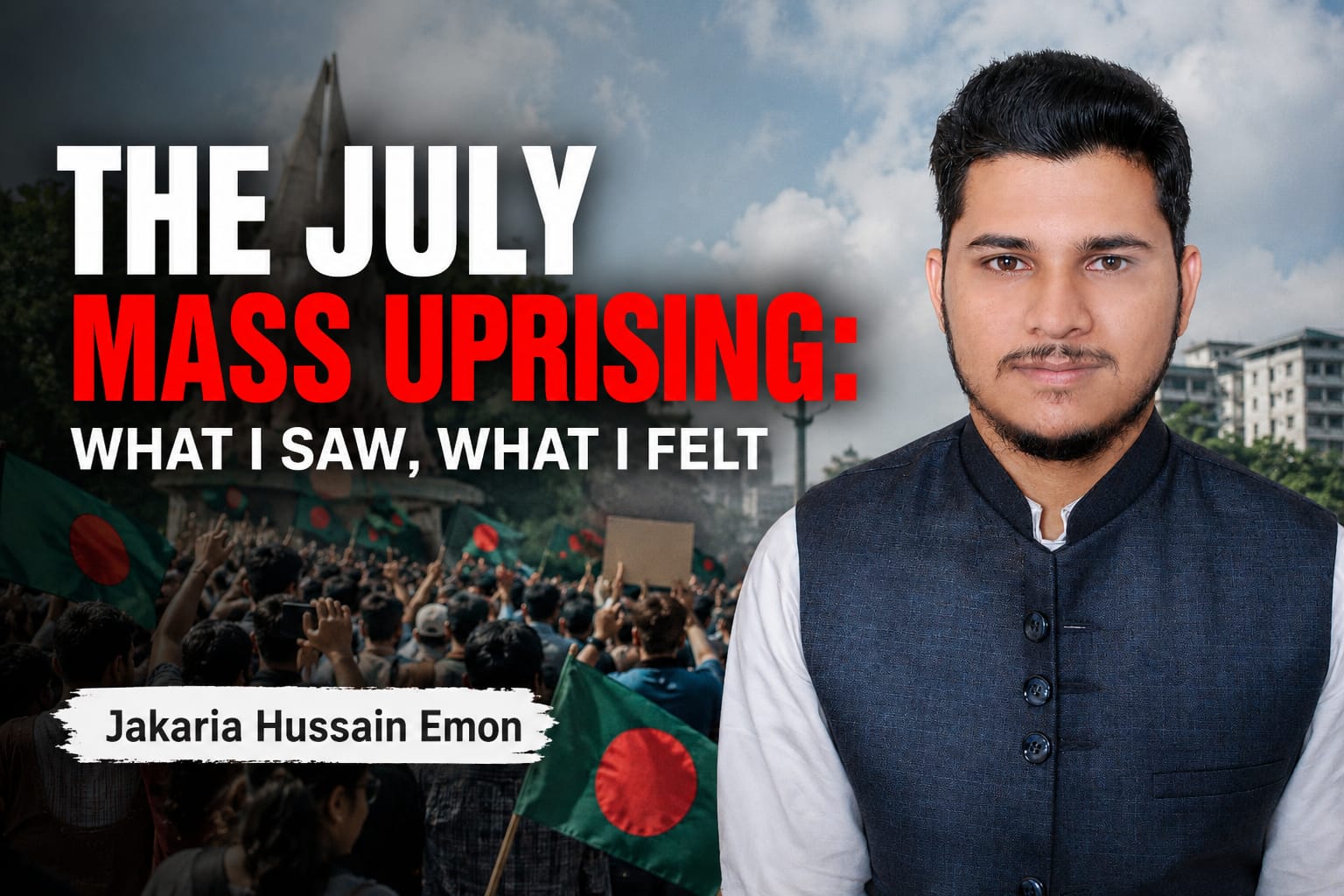 July is a familiar month in the English calendar. Every year it brings the refreshing rains of the Bengali monsoon, but in 2024 it arrived carrying memories of bloodshed, sacrifice, and struggle. Some moments in history transcend the pages of a calendar; they become symbols of a nation's consciousness, courage, and dignity, living on through generations. To me, the July Mass Uprising is not merely an event—it is a profound emotion, an awakened spirit, and one of the most remarkable chapters in our history.
On 1 July, in response to a call from the students of the University of Dhaka—the country's largest and most prestigious educational institution—students from universities across Bangladesh united to demand a fair and rational reform of the existing public sector quota system. Despite days of peaceful demonstrations and various protest programs, the then authoritarian government remained indifferent. On the 14th day of the movement, during a press conference, the head of government insulted the protesting students by referring to them as the "children of Razakars" while responding to a journalist's question. That very night, students from the University of Dhaka and universities across the country defied all fear imposed by the state and responded to the Prime Minister's remarks with a powerful show of unity.
The following afternoon, police and members of the ruling party's student wing attacked the students during their previously announced protest program. Numerous female students were assaulted and humiliated. The brutality outraged the nation, and the movement quickly spread like wildfire across the country.
Moulvibazar, a district in the northeastern region of Bangladesh, soon became one of the centers of resistance. On 16 July, at around 11:00 a.m., several hundred students gathered on the campus of the Government College to protest the violent attacks on students across the country. There, we were attacked by members of the ruling party's student wing, leaving several students injured. After regrouping, we assembled again at the Press Club and marched toward Chowmuhana, where we faced yet another attack.
The following day, 17 July, another procession was organized, but within minutes it also came under attack. On 18 July, at around 11:00 a.m., students once again marched from the Court Area. This time too, members of the student wing armed with sticks attacked the demonstrators, injuring many students, including women. Two students participating in the movement were arrested that day. From then on, the government shut down internet services in an attempt to suppress the protests.
Those of us coordinating the demonstrations became targets of continuous police and intelligence operations aimed at arresting us. After nearly a week, internet services were restored. We held discussions with fellow protesters who had participated in the earlier marches and announced 4 August as the next major day of action. Two days before the scheduled protest, police intensified their operations to arrest the coordinators, including myself. Remaining in hiding, we continued our campaign and encouraged people to join the movement.
After another sleepless night, dawn broke on 4 August. From the very morning, the city was tense. At exactly 12:00 noon, a procession of more than a thousand students marched out from the college gate. By the time we reached Chowmuhana, nearly 10,000 people had joined the demonstration. Members of the ruling party's student wing attacked the unarmed protesters with locally made weapons. Nearly two hours of clashes and resistance left more than fifty students injured. Eventually, the attackers were forced to retreat under pressure from the students.
However, the police soon launched another assault, firing tear gas and shotgun pellets, injuring hundreds more. In those difficult moments, people from every walk of life in Moulvibazar stood beside the injured students, providing every possible form of assistance. That day, Moulvibazar witnessed one of the darkest and most painful chapters in its history.
Another sleepless night passed for the nation.
On 5 August, internet services were once again suspended from the morning. Around 12:00 noon, the internet was briefly restored, and news spread that the Army Chief would address the nation at 2:00 p.m. By then, the country's long-ruling leader had fled. After sixteen years marked by allegations of killings, enforced disappearances, torture, repression, and authoritarian rule, the government had fallen.
Like millions across Bangladesh, the people of Moulvibazar erupted in celebration. Before the afternoon had passed, men, women, children, and the elderly filled the streets. With red cloth tied around their heads, hearts overflowing with relief, and tears in their eyes for the countless martyrs, people celebrated in the rain. It was a joy beyond words—a celebration without limits.
Thus, after sixteen long years, the people finally experienced the taste of freedom.
--
Jakaria Hussain Emon
Coordinator, Anti-Discrimination Student Movement, Moulvibazar
Syed Mujtaba Ali Road, Moulvibazar-3200
 প্রিন্ট করুন
 সেভ করুন