November 22, 2026, 4:32 pm
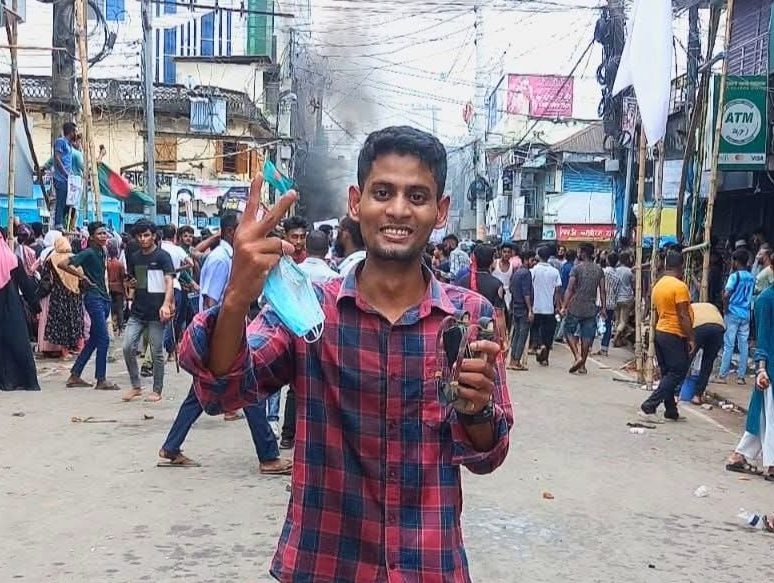
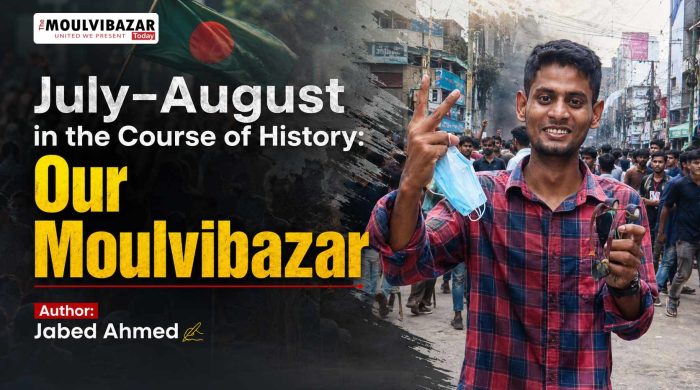

I begin with 18 July 2024. The entire country was in turmoil over the quota reform movement. Protest rallies and demonstrations were taking place in almost every district of Bangladesh. In Moulvibazar, under the banner of the Students Against Discrimination Movement, general students organized a protest march.
The march was scheduled to begin at 12:00 PM in front of the Press Club. At that time, I was serving as the President of the South Branch of Moulvibazar Sadar Upazila of Islami Chhatra Shibir. Tarek Aziz, the former President of the Moulvibazar City Branch of Shibir, told me that we had to ensure our members in the city joined the protest organized by the general students at the Press Club. Meanwhile, after learning about the planned demonstration, members of the Chhatra League had been gathering at the Press Club since morning, displaying locally made weapons. Some of our members were also positioned around the Press Club.
My responsibility was to ensure that our members could participate in the march by any means possible. I left home on my bicycle, carrying only a basic mobile phone and leaving my Android phone behind. At that time, I avoided taking my Android phone into the city because it contained a great deal of information, and throughout July the police had been regularly visiting my home.
When I reached the Press Club at exactly 12:00 PM, I saw that the Chhatra League had chased away several of our supporters using locally made weapons, scattering them. After waiting for quite some time, it was around 1:30 PM. The general students had also failed to arrive at the scheduled time because of the Chhatra League’s presence. I called Tarek Aziz and said, “Brother, the general students couldn’t come because of the Chhatra League. What should we do?” He told me to leave with our members.
I left with several of our members, while some others remained around the Press Club and the court area. As soon as I reached home, I received news that several general students had brought out a procession at Sakura Market, where they were jointly attacked by the Chhatra League and the police. A few of our members were present there as well. That day, we were unable to do much.
Later, we decided to build a large movement involving all the students of Moulvibazar. At that time, Masud Rana Tuhin, then Secretary of the Moulvibazar City Branch of Shibir and now President of Sylhet University of Science and Technology, planned to accelerate the movement by establishing contact with students across the district. The responsibility for communicating with general students was assigned to Sumon Bhuiyan, former Secretary of Shibir at Moulvibazar Government College. He contacted the general students and planned a major movement for 4 August.
Our responsibility on 4 August was to protect the general students at any cost. We needed sticks for self-defense. Under the plan of Kazi Daiyan Ahmed, President of the Moulvibazar City Branch of Shibir, and with the assistance of another brother, we arranged sticks around midnight on 3 August, transporting them by ambulance from a union at the far end of Moulvibazar Sadar Upazila. That night, I was accompanied by Jiaur Rahman, HRD Secretary of Shibir, and another responsible brother.
Meanwhile, many people from the Students Against Discrimination Movement’s WhatsApp group called me, saying that members of the Chhatra League had threatened them over the phone not to join the movement. They warned that the Chhatra League had made extensive preparations for 4 August, including both locally made and foreign weapons. I encouraged everyone and tried to strengthen their resolve. In particular, Dewan Muaz, the son of the late Dewan Sirajul Islam Motlib, former Ameer of Bangladesh Jamaat-e-Islami’s Moulvibazar District, provided valuable advice and planning assistance.
After a sleepless night, morning arrived. The plan for 4 August was for every member of Shibir from both the district and city branches to remain active in the field. The city was flooded with Chhatra League members and police, making it impossible to transport the sticks to the College Point.
I called Ruman Ahmed, then former HRD Secretary of the Moulvibazar City Branch of Shibir. He came after great difficulty and managed to arrange a three-wheeled auto-rickshaw (tomtom). We loaded the sticks onto it. At that time, I was accompanied by several frontline activists of the Students Against Discrimination Movement.
After much difficulty, we were heading toward College Point through Kazirgaon Road when Detective Branch (DB) police stopped the vehicle. Somehow, we managed to leave the area safely and joined the movement at Chowmuhana. There, I met Md Abdul Munyeem, former President of Shibir at Moulvibazar Government College; Abdullah Al Mamun, former Office Secretary of the Moulvibazar City Branch of Shibir; Mustakim Ahmed, current City Secretary of Shibir; Foysal Ahmed, current Office Secretary; Md Sayem Ahmod, President of Shibir at Moulvibazar Government College; Abdullah Al Apon, Secretary of the Rajnagar South Branch; and many other brothers.
The intense movement began. On one side stood the police, on the other side the Chhatra League, and in the middle were we—the general students—engaged in a fierce struggle. Elsewhere, from an unknown location, our responsible brothers were praying to Almighty Allah on prayer mats for our success and protection.
Soon, people from every section of Moulvibazar society joined us, along with students, ordinary citizens, and activists from various organizations. In particular, I spoke with several brothers from Jatiyatabadi Chhatra Dal, who also became actively involved. Many brothers from Bangladesh Jamaat-e-Islami supported us by providing water and food.
4 August became a revolutionary day in the history of Moulvibazar—a revolution in which we emerged victorious, while Sheikh Hasina’s authoritarian regime and its violent supporters were defeated.
The participants in that great uprising included people from every walk of life in Moulvibazar, activists of the Students Against Discrimination Movement, leaders and activists of the BNP, Bangladesh Jamaat-e-Islami, other Islamic parties, respected college and madrasa teachers, and many others.
The history of 4 August cannot be fully told. Everyone knows who contributed and in what way. We have no need to claim credit, but history must be presented for the sake of those who attempt to distort it. Sadly, we now see how the history of 4 August has been distorted. The greatest lesson of history is that people do not learn from history.
Inqilab Zindabad.
Author: Jabed Ahmed
School and Science Secretary
Bangladesh Islami Chhatra Shibir
Moulvibazar City Branch