November 22, 2026, 10:22 pm

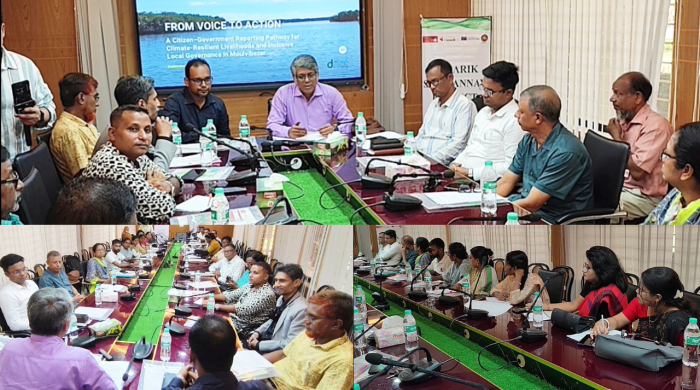

Stakeholders at a consultation workshop in Sreemangal have called for establishing an effective and accountable citizen-government reporting mechanism to turn citizens’ concerns and needs into government action.
They said government services and programmes alone are not enough. Effective channels must also be ensured for marginalized people to learn about available services, access them, report problems and track the progress of government responses.
The consultation workshop titled “From Voice to Action: Citizen-Government Reporting Mechanisms for Climate-Resilient Livelihoods and Inclusive Local Governance” was held on Monday, September 14, at the Sreemangal Upazila Parishad auditorium.
Speakers included Dnet Executive Director Mahmud Hasan, “Nagorik Samanway” Project Manager Asif Ahmed, Upazila Social Services Officer Suyeb Hossain Chowdhury, Youth Development Officer Asim Kumar Kar and others.
Representatives of the local administration, journalists, civil society organizations (CSOs), community-based organizations (CBOs), Dnet’s executive director and project manager, and other stakeholders participated in the workshop.
During the discussion, speakers said that although various government programmes and services exist for social protection, livelihoods, climate resilience and disaster risk management, many marginalized citizens—including women, tea workers, ethnic minority communities, persons with disabilities, small farmers and young people—often cannot access these benefits.
They said this gap is created by various factors, including lack of information, complicated procedures and difficulties in reaching the responsible institutions.
Stakeholders emphasized that “service availability” and “access to services” are not the same thing. Therefore, it is essential both to ensure that citizens’ concerns reach the relevant institutions and to inform the public about the progress of government action.
Dnet Executive Director Mahmud Hasan said, “Moulvibazar does not need just another mechanism for people to voice their concerns; it needs a strong system through which people will be heard, connected with the relevant institutions, receive a response, and be informed about the outcome.”
The workshop also highlighted the role of local CSOs and CBOs. Speakers said these organizations can act as a bridge by listening to citizens’ problems and needs, documenting information, communicating them to the relevant institutions and following up on the progress of government responses.
Asif Ahmed Tanmoy, Project Manager of the “Nagorik Samanway” project, said, “Many problems and needs of marginalized people are emerging at the grassroots level. What is needed now is to communicate these issues to the relevant government institutions through a structured process and inform the people about the responses.”
The workshop clarified that the objective of the initiative is not to create any new committee or parallel system, but rather to make existing institutions more accessible, responsive and accountable to the people.
It was noted that the “Nagorikota – Civic Engagement Fund (CEF)” programme’s “Nagorik Samanway” project in Moulvibazar is being implemented through Dnet and its partner organizations, funded by Switzerland, Canada and the European Union and managed by the GFA Consulting Group.