Photo: Collected

November 22, 2026, 9:33 pm

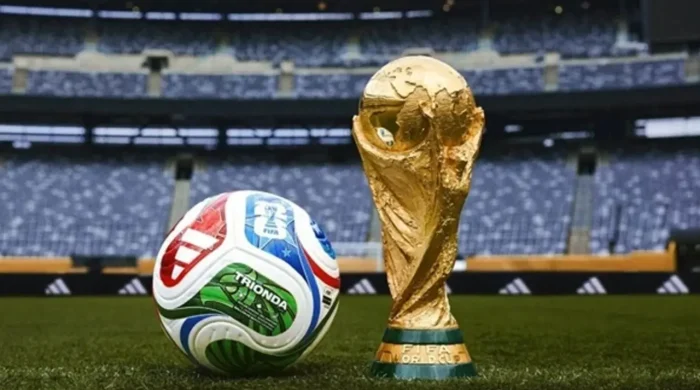

The FIFA World Cup is not only about glory on the pitch—it also offers enormous financial rewards. The 2026 edition will feature the highest prize money in the tournament’s history. Co-hosted by the United States, Canada, and Mexico, it will also be the largest World Cup ever staged.
The expanded tournament will feature 48 teams, 104 matches, and will be played over 39 days. Along with the increase in the number of teams and matches, the tournament’s financial rewards have also grown significantly. FIFA initially announced a total prize fund of $727 million (approximately BDT 89.7 billion), which was 50% higher than the amount distributed during the 2022 FIFA World Cup in Qatar.
However, in April, FIFA approved an increase in participation payments and preparation grants, raising the total prize pool to $871 million (approximately BDT 107.46 billion). This represents a 65% increase compared to the $440 million prize fund awarded at the 2022 World Cup.
According to the BBC, $655 million of the total prize fund will be distributed as performance-based prize money, while the remaining $216 million will be allocated for preparation, logistics, travel, accommodation, and other operational support. These funds will be paid directly to the participating national football associations rather than individual players. Typically, players receive 20–30% of these federation allocations.
Under FIFA’s financial model, every team that qualifies for the World Cup is guaranteed $10 million as a qualification payment, along with an additional $2.5 million to cover travel, logistics, administrative expenses, and delegation costs.
The $10 million qualification payment comes from FIFA’s commercial revenues generated through broadcasting rights, sponsorships, ticket sales, hospitality, and licensing. It is not a performance bonus but a qualification fee paid directly to each country’s football federation.
As a result, every qualified team is guaranteed a total of $12.5 million (approximately BDT 1.54 billion) before playing a single match. The 2026 FIFA World Cup champions will receive an additional $50 million in performance-based prize money (approximately BDT 6.17 billion), which is $8 million more than Argentina received for winning the 2022 World Cup.
The runners-up will earn $33 million (approximately BDT 4.07 billion), the third-place team will receive $29 million (approximately BDT 3.58 billion), and the fourth-place finisher will take home $27 million (approximately BDT 3.33 billion).
Teams eliminated in the quarter-finals will receive an additional $19 million (approximately BDT 2.34 billion) in performance prize money, bringing their total earnings to $31.5 million including qualification and preparation payments. The four quarter-finalists eliminated at this stage are Morocco, Belgium, Norway, and Switzerland.
Teams knocked out in the Round of 16 will receive $15 million (approximately BDT 1.85 billion) in prize money, taking their total earnings to $27.5 million. The teams eliminated in this round are Brazil, Mexico, Portugal, the United States, Egypt, Colombia, Canada, and Paraguay.
Teams eliminated in the Round of 32 will earn $11 million (approximately BDT 1.36 billion) in performance prize money. Therefore, Germany, the Netherlands, Croatia, Japan, Sweden, South Africa, Senegal, Algeria, Ivory Coast, Ecuador, DR Congo, Bosnia and Herzegovina, Austria, Cape Verde, Australia, and Ghana will each receive $23.5 million in total, including the guaranteed qualification and preparation payments.
Even teams eliminated in the group stage will not leave empty-handed. Each of the 16 teams exiting the tournament at this stage will receive $9 million (approximately BDT 1.11 billion) in performance prize money, in addition to the guaranteed $12.5 million, bringing their total earnings to $21.5 million. The teams eliminated in the group stage are South Korea, the Czech Republic, Qatar, Scotland, Haiti, Türkiye, Curaçao, Tunisia, Iran, New Zealand, Uruguay, Saudi Arabia, Iraq, Jordan, Uzbekistan, and Panama.
FIFA said that the record-breaking prize fund has been made possible by the expansion to 48 teams, which has significantly increased revenue from broadcasting rights, sponsorship deals, commercial partnerships, ticket sales, and hospitality. A substantial portion of that additional income is being redistributed among the participating nations, making the 2026 FIFA World Cup the most financially rewarding tournament in football history.