Photo: Collected

November 22, 2026, 10:09 pm

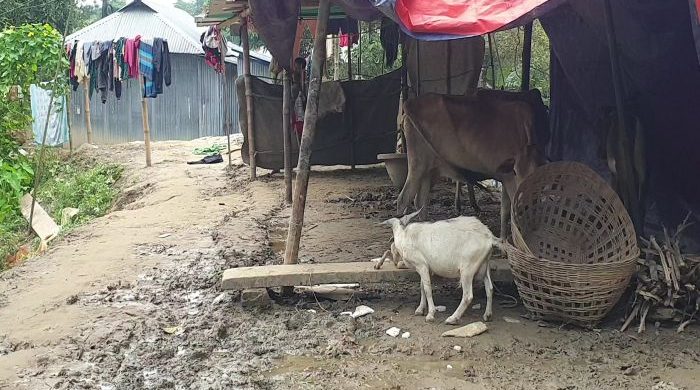

Residents living along the Manu River in Moulvibazar’s Rajnagar Upazila have begun returning to their homes as floodwaters recede, but the trauma of the devastating floods continues to haunt families who lost their homes, belongings, crops, and livestock.
The disaster unfolded after three consecutive days of heavy rainfall combined with upstream water from India caused the Manu and Dhalai rivers to overflow. On July 9, a major breach developed in the flood protection embankment at Ujirpur in Tengra Union, sending torrents of water into nearby villages.
Despite desperate efforts by local residents to reinforce the embankment with sandbags, the powerful current swept through Ujirpur, Ekamdhu, and surrounding villages, inundating homes, roads, and farmland. The following morning, another embankment located about half a kilometre away also collapsed, worsening the flooding across 30 villages in five unions, including Tengra, Tarapasha, and Mansurnagar. Nearly 50,000 people were left stranded by floodwaters.
Police also recovered two bodies carried by the floodwaters in Ujirpur, including 70-year-old Ashraf Mia Ashai from Ekamdhu village and an unidentified teenage girl.
The worst-hit communities were Ujirpur and Ekamdhu, where many residents had only moments to escape as floodwaters rushed into their homes. Many fled with nothing but the clothes they were wearing, watching helplessly as rice, furniture, clothing, livestock, poultry, and household belongings were swept away.
Displaced families took shelter on flood-control embankments, in temporary shelters, or at relatives’ homes until the water began to recede.
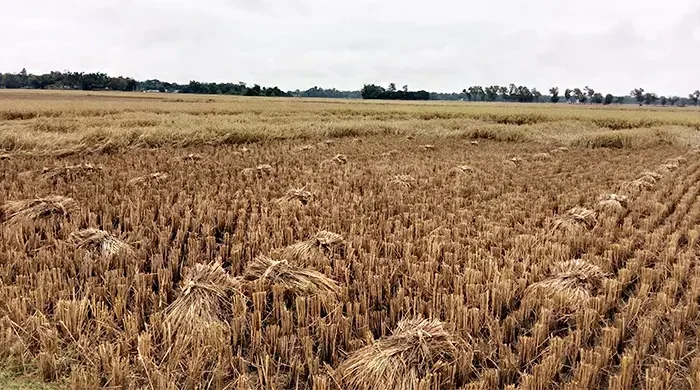
Returning home has brought little relief. Many families found their houses still standing, but almost everything inside had been destroyed. Stored rice and food supplies had spoiled, furniture was damaged, and in many cases, roofing sheets had been torn away by the force of the water. Farmland, vegetable fields, and seedbeds were also severely affected, leaving many uncertain about how they will rebuild their lives.
Sabana Begum, a resident of Ekamdhu village, said the flood washed away nearly everything her family owned.
“The water swept away our ducks, chickens, goats, furniture, and food. Two of our goats died in the flood. We spent three days on the embankment without enough food. Now we’ve returned home, but there’s almost nothing left,” she said.
Lina Dey of Ujirpur village recalled how quickly the disaster unfolded.
“The embankment collapsed around 4:30 in the afternoon. We never imagined the water would reach our homes. Within moments, it looked like a tidal wave. Everything was submerged. A rescue boat finally took us to safety late at night. When I came back, my home was covered in mud and everything had been ruined,” she said.
Farmer Abdul Aziz said floodwaters rose to the roof of his house.
“Our rice, vegetables, seedbeds, and household belongings were destroyed. The current was so strong that we couldn’t even save a blanket,” he said.
According to the District Relief and Rehabilitation Office, the floods affected 1,840 families, with 1,439 houses partially damaged and 2,493 houses completely destroyed. Official figures show that more than 34,000 people were affected by the disaster across the district.
District Relief and Rehabilitation Officer Mohammad Chadu Mia said the government has already requested corrugated iron sheets from the ministry to help families rebuild homes that were completely destroyed in the floods.