November 22, 2026, 10:11 pm

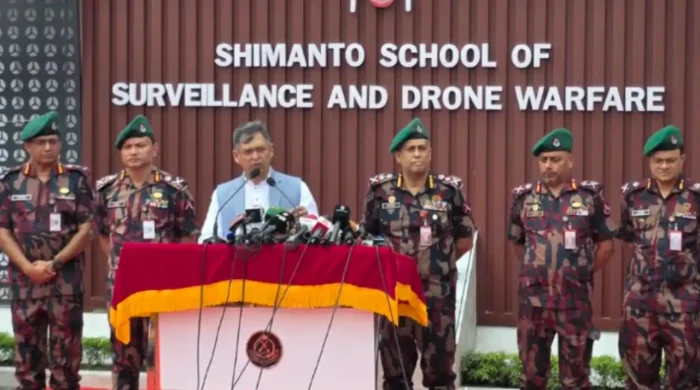

Home Minister Salahuddin Ahmed has said that existing laws are sufficient to take action against incidents of mob violence or people taking the law into their own hands. He said there is no need to enact a separate law for this purpose.
“We are very alert and aware. We will firmly tackle the culture of mob violence that has developed in Bangladesh, InshaAllah,” he said.
The minister made the remarks while speaking to journalists after inaugurating the Border School of Surveillance and Drone Warfare at the Border Guard Bangladesh (BGB) Sector Headquarters in Sylhet on Tuesday (September 1).
He said the government is strengthening the legal framework and law enforcement structure, while manpower and technological support will be provided to the forces and relevant departments. He expressed hope that such incidents would come under control.
Regarding border surveillance, Salahuddin Ahmed said digital surveillance, night-mission systems and thermal drones would be used in areas where manual monitoring with manpower is difficult or impossible. These technologies will help identify people on the other side of the border and detect activities such as smuggling of drugs and weapons.
He said initiatives have been taken to manufacture and assemble drones for the BGB using domestic technology. “We are also assembling and manufacturing these here, and in the future, this could develop into a defence industry for us,” he said.
The minister also directed authorities to maintain strict drone-based surveillance in remote border areas to ensure security and control criminal activities. He said thermal and night-mission-capable drones would be deployed where monitoring with limited manpower is difficult. Digital technology-based surveillance will also be expanded to prevent smuggling, drug and arms trafficking, human trafficking and illegal entry.
Speaking about the inauguration of the Border School of Surveillance and Drone Warfare, he described the establishment of the BGB training centre and the launch of its training activities as a unique development in Bangladesh’s history. He said digital initiatives are being expanded across various forces and educational institutions as part of efforts to build a knowledge-, technology- and merit-based Bangladesh.
Regarding drug control, the minister said 181 drug-related cases had been decided in Sylhet over the past one and a half years, with accused persons being acquitted in nearly half of them. He attributed the acquittals partly to the large number of cases, limited investigative capacity, inadequate manpower and shortcomings in the previous law.
He said many of the cases were filed under the old law, which did not provide for specialised tribunals. He cited the large number of pending drug cases in Dhaka, Cox’s Bazar and Chattogram as examples of the pressure on the judicial and investigative systems.
The minister said the new Narcotics Control Act has strengthened the Department of Narcotics Control and introduced measures to make investigations and judicial proceedings more effective. The new framework also addresses emerging forms of crime, including the use of cyberspace in drug trading.
He said arrangements have been made to establish storage facilities and lock-ups in every district, while the law also provides for the introduction of dog squads in anti-drug operations. Steps are also being taken to provide weapons and training to officials and employees of the Department of Narcotics Control.
According to the minister, drug dealers often use sophisticated weapons, while narcotics control officials previously lacked access to similar equipment. The new system includes provisions for providing them with necessary weapons and training.
He said steps are also being taken to identify those involved in drug trafficking and drug dealing, bring them under the law and ensure the maximum punishment.
The minister added that the BGB would assist the Department of Narcotics Control in controlling drugs and smuggling along border areas. He said increased manpower and technological capacity would enable authorities to take faster action against drug-related crimes and make the judicial process more effective.
Regarding the acquittals in drug cases in Sylhet, Salahuddin Ahmed said accused persons may have benefited from legal provisions because of the large backlog of cases. However, he stressed that there is no lack of government commitment to controlling drugs.
Later on Tuesday, the minister was scheduled to attend a special review meeting at Sylhet Circuit House with senior officials of the district administration and law enforcement agencies to discuss the overall law and order situation and development activities in Sylhet.
He was also scheduled to address a discussion meeting organised by the Sylhet District BNP at the Sylhet District Shilpakala Academy to mark the 48th founding anniversary of the Bangladesh Nationalist Party (BNP).